A local guide to the history, culture and hidden places of the U.S. Virgin Islands’ capital.
Ask a first-time visitor what they plan to do in St. Thomas and the answers tend to come quickly: go to the beach, snorkel in clear Caribbean water, drink a rum cocktail, perhaps take an island tour and buy something duty-free.
All perfectly respectable pursuits. But they leave out one of the most interesting experiences on the island: walking Charlotte Amalie.
The capital of the U.S. Virgin Islands is far more than the shopping district visitors glimpse through a taxi window on their way to Magens Bay. Charlotte Amalie is one of the Caribbean’s great historic port towns—a place where Danish colonial architecture, African and Afro-Caribbean culture, Jewish history, maritime commerce, emancipation, religion, migration and modern Virgin Islands life overlap within a remarkably compact area.
The old town’s significance is formally recognized by the Charlotte Amalie Historic District on the National Register of Historic Places. The district matters not only for its architecture but for its connections to commerce, government, European settlement and Black history.
Charlotte Amalie developed around one of the finest natural harbors in the Caribbean. During the Danish colonial era, ships arrived carrying goods and people from Europe, Africa, North America, South America and other Caribbean islands. Warehouses filled with merchandise. Merchants established trading houses. Sailors crowded the waterfront. Enslaved Africans and their descendants performed much of the labor upon which the colonial economy depended.
Later came emancipation, changing patterns of immigration, the 1917 transfer of the Danish West Indies to the United States, the decline of sail, the rise of tourism and the arrival of modern cruise ships. Remarkably, much of the physical framework of that older city survives.
Quick Guide: The Best Things to Do in Charlotte Amalie
| Attraction | Best for | Suggested time | Cost |
|---|---|---|---|
| Fort Christian | Colonial and political history | 45–60 min. | $10 |
| Emancipation Garden | Emancipation and Black history | 20–30 min. | Free |
| 13 Wimmelskafts | Social history and local culture | 45–90 min. | Free admission |
| St. Thomas Historical Trust Museum | Island history | 30–60 min. | Free; donations appreciated |
| 99 Steps | Architecture and photography | 30–45 min. | Free |
| Blackbeard’s Castle | History, views and folklore | 60–90 min. | Currently $15 |
| St. Thomas Synagogue | Jewish history and architecture | 30–45 min. | Donations appreciated |
| Frederick Lutheran Church | Danish and religious history | 20–30 min. | Free when open |
| Government House | Architecture and government | 15–30 min. | Access varies |
| Alvaro de Lugo Post Office | Art and 20th-century history | 5-10 min. | Free |
| Main Street | Architecture and commerce | 45–90 min. | Free |
| Rothschild Francis Square | Black and economic history | 20–30 min. | Free |
| Saints Peter and Paul Cathedral | Art and religious history | 20–30 min. | Free when open |
| Frenchtown and French Heritage Museum | Living local culture | 45–90 min. | Verify before visiting |
| Hassel Island | Maritime and military history | 2½–3 hrs. | Guided tour |
Map of Historic Charlotte Amalie
Most attractions in this guide are concentrated in the old town and can be explored on foot. Frenchtown lies west of the historic core, while Hassel Island requires a boat trip. Use the map to orient yourself, then open any location below for directions.
1. Explore Fort Christian
If there is one place from which to begin understanding Charlotte Amalie, it is Fort Christian. Begun during the earliest period of permanent Danish settlement in the 1670s, it is regarded as the oldest standing structure in the U.S. Virgin Islands and one of the city’s defining landmarks.
Its familiar red walls are photogenic, but the fort is more important than its appearance suggests. Across the centuries it has functioned as a fortification, seat of government, courthouse, jail and place of worship. Many of the mechanisms through which colonial authority operated on St. Thomas were once concentrated within these walls.
Stand outside and look toward the harbor, then turn toward the town rising behind you. Charlotte Amalie developed around the relationship between harbor, defense, government and commerce. Ships arrived below, merchant houses spread behind the waterfront, government institutions occupied prominent sites and residential neighborhoods climbed the surrounding hills.
The fort now functions as a museum and cultural site with exhibitions connected to Virgin Islands history. Check current visitor information before your visit.
2. Pause in Emancipation Garden
Beside Fort Christian is a comparatively small public square carrying enormous historical meaning. Emancipation Garden commemorates emancipation in the Danish West Indies on July 3, 1848.
The abolition of slavery did not arrive simply as a gift from colonial authorities. It came amid a major uprising on St. Croix and tremendous pressure from enslaved Virgin Islanders themselves. Governor-General Peter von Scholten ultimately proclaimed emancipation, and July 3 remains one of the most significant dates in Virgin Islands history.
The garden’s placement beside Fort Christian creates a powerful contrast. On one side stands a symbol of colonial military and administrative power; beside it is a landscape dedicated to freedom from one of that system’s defining institutions. Look for the memorials and the Freedom sculpture, often called the Conch Blower.
3. Visit 13 Wimmelskafts Slave House Museum & Garden
Travelers looking for museums in St. Thomas—or places where Charlotte Amalie’s history can be experienced at a more human scale—should make time for 13 Wimmelskafts.
Only a short walk from Fort Christian and one street inland from Main Street, the property contains a surviving nineteenth-century building associated with the enslaved and servant population of a substantial Charlotte Amalie household. The surviving structure dates to roughly 1830, before emancipation in 1848.
That distinction matters. Much of the architecture preserved from colonial societies belonged to governments, wealthy merchants, churches, military institutions and prosperous families. The physical spaces occupied by enslaved people and working-class residents were far more likely to disappear.
At 13 Wimmelskafts, history begins with questions about daily life. Where did people sleep? Where was food prepared? How much privacy existed? What did domestic labor look like? How did enslaved people create families, relationships and communities within a system that denied them fundamental freedoms?
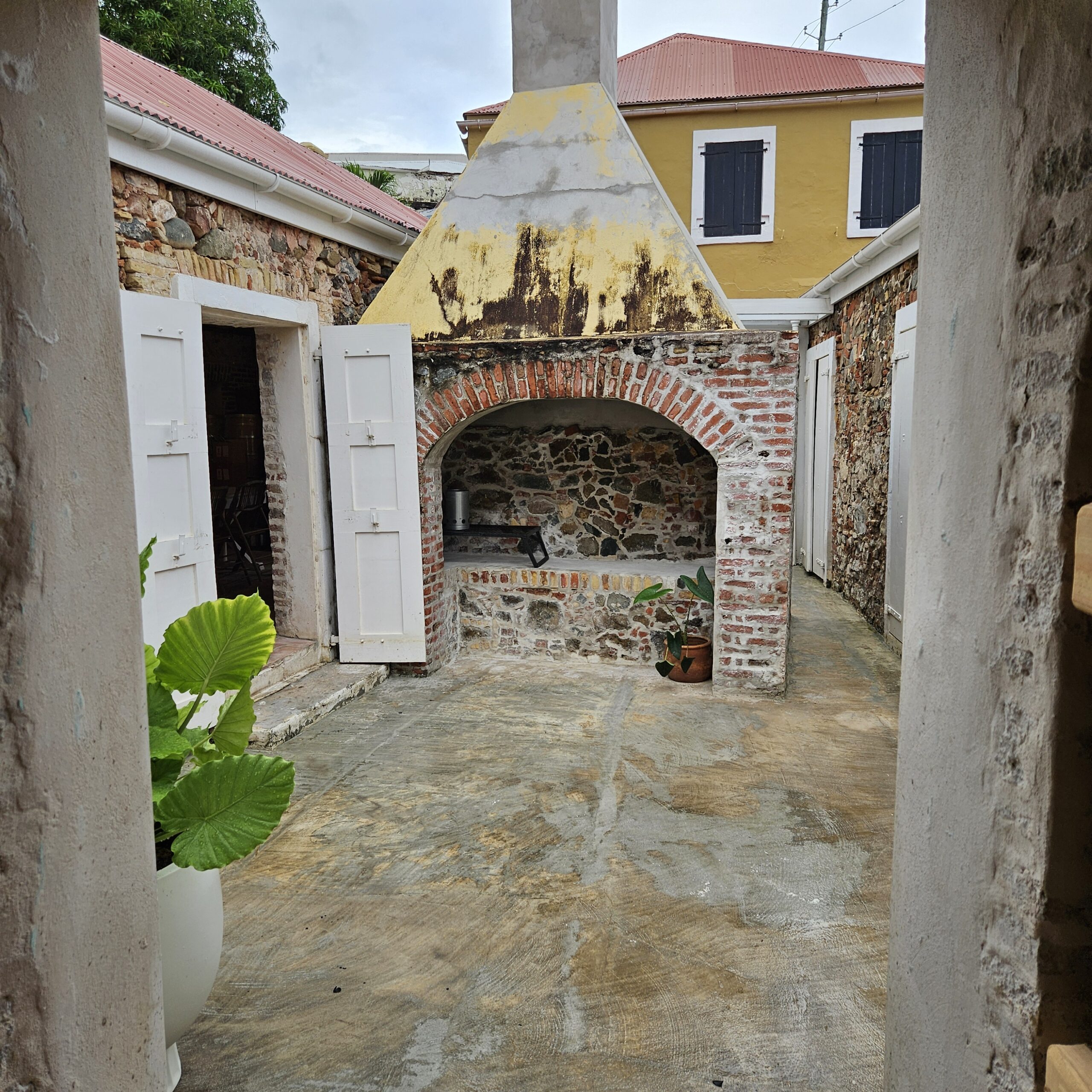
The museum collection expands the story through material related to the Danish West Indies, maritime Charlotte Amalie, Indigenous history, maps, documents, photography and later Virgin Islands life. Behind the historic structure is a shaded tropical garden—a reminder that this was a domestic world where people cooked, worked, slept, talked, argued and raised children.
The site is also part of contemporary Charlotte Amalie rather than a frozen reconstruction. Rum, coffee and hot sauce are produced on the property, continuing—in a modern and very different form—the old town’s tradition of production and trade.
Museum and garden admission is free. The site generally opens on cruise-ship days from 10 a.m. to 2 p.m.; verify before making a special trip. Read the history or explore the collection.
4. Discover the St. Thomas Historical Trust Museum
For visitors who want to understand what they are seeing while walking around Charlotte Amalie, the St. Thomas Historical Trust Museum is one of the most useful stops in town. It occupies an appropriate setting on Raadets Gade between Main Street and the waterfront.
The collection includes Caribbean art and antiques, old photographs and paintings, archaeological material and objects recovered from shipwrecks in Charlotte Amalie Harbor. Some pieces date back several centuries. It is not an enormous metropolitan museum—and that is part of its appeal. Many objects relate directly to buildings and streets only a few steps outside the door.
The Trust currently lists museum hours as Monday through Friday, 10 a.m. to 2 p.m. Admission is free, with donations appreciated. Hours can change, so verify before visiting.
5. Climb the 99 Steps—and Explore the Step Streets
The 99 Steps may be Charlotte Amalie’s most photographed pedestrian route, but the stairs become more interesting when understood as part of an entire urban system. The city rises sharply from its harbor. Step streets moved people directly between the commercial district at sea level and neighborhoods climbing the hills.
The name is somewhat misleading: the staircase visitors climb today contains more than 99 individual steps. Numerical accuracy has never posed much threat to a good island name.
The steps are traditionally associated with bricks carried across the Atlantic aboard Danish vessels. Ships required ballast for stability, and building material arriving as ballast could be reused in the growing colonial town.
Look for old retaining walls, doorways, unexpected gardens, brickwork and sudden harbor views. Most importantly, do not treat the 99 Steps as the only stairs worth climbing. Charlotte Amalie rewards curiosity.
Practical note: Wear shoes with reliable grip, carry water and avoid the steepest climb during the hottest part of the day.
6. Visit Blackbeard’s Castle—and Meet Skytsborg
Above downtown stands one of Charlotte Amalie’s oldest surviving structures. Nearly everyone knows it as Blackbeard’s Castle. Its older and historically revealing name is Skytsborg.
The Danish watchtower dates to 1679 and occupied an obvious strategic position above the harbor. From here, approaching vessels could be observed much earlier than from sea level. The claim that Blackbeard personally used the tower as his private lookout belongs more comfortably to tourism tradition than firmly established documentary history.
The authentic history is arguably more interesting. Skytsborg was part of the defensive infrastructure of a colonial Caribbean port when naval warfare, privateering, smuggling, piracy and imperial rivalry were everyday realities.
The attraction currently lists the tower and grounds as open daily from 9 a.m. to 5 p.m., with general admission of $15. The harbor view requires no embellishment. Check current hours and admission.
7. Step Inside the Historic St. Thomas Synagogue
The Hebrew Congregation of St. Thomas preserves something remarkable: a historic institution that remains alive. Jewish settlement on St. Thomas dates back centuries, and the organized congregation was established in 1796. The present building was dedicated in 1833 after several earlier synagogue buildings were lost to fire.
Mahogany pews made by shipbuilders face the ark. Crystal chandeliers hang below a high ceiling. Beneath your feet is sand. The sand-covered floor is associated with the memory of Sephardic Jews who practiced their religion under persecution.
This is not merely an attraction; it remains a functioning congregation. That continuity—people worshipping today in a building used by generations before them—is what makes it so powerful. Visit respectfully and confirm current access through the congregation’s official site.
8. Visit Frederick Evangelical Lutheran Church
Frederick Evangelical Lutheran Church represents an aspect of colonial society easily overlooked when visitors concentrate on forts and warehouses. Religion and government were deeply intertwined under Danish rule, and Lutheranism was Denmark’s established religion.
The congregation’s importance extends beyond Danish officials. Across generations, the church became part of the religious life of Virgin Islanders themselves. Its story spans colonial rule, slavery, emancipation, the transfer to the United States, twentieth-century modernization and contemporary Virgin Islands life.
When the church is open, enter quietly and remember that some of the most significant historic buildings are those that never stopped performing their original purpose.
9. See Government House
From the commercial district, Charlotte Amalie climbs toward Government House, one of the city’s most prominent nineteenth-century structures. Dating to the Danish period, it continues to serve the government of the U.S. Virgin Islands.
Its elevated location is revealing. Government was meant to be seen. The formal façade, staircase and prominent site communicated political authority to merchants, residents and visitors approaching from below. Today the political order is very different, yet the building’s continued public use creates a fascinating connection between Danish Charlotte Amalie and the modern Virgin Islands.
Access varies because this is a working government building. Even viewed only from outside, it fits naturally into a route connecting Main Street, the synagogue, the step streets and Blackbeard’s Castle.
10. Find the Murals Inside the Alvaro de Lugo Post Office
One of the city’s most overlooked cultural attractions is hiding inside a place people normally enter to buy stamps. The Alvaro de Lugo Post Office contains murals by American artist Stevan Dohanos, created during the New Deal era of federal art patronage.
Travel writing sometimes leaps from Danish colonialism directly to cruise ships, leaving out most of the twentieth century. The United States purchased St. Thomas, St. John and St. Croix from Denmark in 1917, and the islands then underwent major political and economic changes. The murals belong to that period and preserve a mainland artist’s interpretation of Virgin Islands life, landscape and commerce.
There is something satisfying about finding significant public art in an ordinary civic building. Remember that it remains a functioning post office.
11. Walk Main Street and the Historic Merchant District
You do not have to buy a diamond to appreciate Main Street. In fact, one of the best things you can do is temporarily ignore the shop windows and look up.
Historic Main Street is Dronningens Gade, or Queen Street, one of the principal commercial streets of old Charlotte Amalie. The architecture developed for a reason: Charlotte Amalie was a trading city. Goods moved from ships through waterfront warehouses and into merchant establishments. Courtyards, passages, storage rooms and shops belonged to an Atlantic system linking St. Thomas to ports around the world.
Fire also shaped the city. Major conflagrations repeatedly damaged Charlotte Amalie, particularly in the nineteenth century. Reconstruction encouraged masonry construction and contributed to the character visitors see today.
Walk slowly. Look for arches, heavy shutters, brick passages, courtyards and old hardware. Imagine the district before automobiles, air conditioning and cruise tourism—when the soundscape was horses, carts, merchants, dock workers and sailors. Shopping is simply the latest chapter in Main Street’s much longer commercial history.
12. Visit Rothschild Francis Square—the Old Market Square
At the western edge of the traditional commercial district is a place whose history is more complicated than its modest appearance suggests. Today it is called Rothschild Francis Square; generations knew it as Market Square.
The area functioned as a market where people bought and sold food, fish, produce and household goods. Market women became especially important figures in Caribbean economic and social life, creating income, independence and community networks across generations.
Colonial commerce here also included the buying and selling of enslaved human beings. The square therefore carries several histories at once: slavery and emancipation, Black entrepreneurship and the economic power of Virgin Islands market women.
Its modern name honors Rothschild Francis, the influential Virgin Islands journalist, activist and political figure who fought for greater civil and political rights. A public space once connected with enslavement now carries the name of a Black Virgin Islander associated with political empowerment.
13. Step Inside Saints Peter and Paul Cathedral
Charlotte Amalie’s religious buildings reveal how cosmopolitan this small Caribbean port became. Saints Peter and Paul Cathedral tells an important part of that story.
Catholic ministry on St. Thomas can be traced to the eighteenth century. The cathedral’s official history dates the community’s beginnings to 1773, when an Italian Franciscan priest began serving Catholics on the island. The building later underwent repeated reconstruction, expansion and restoration.
Inside are murals completed by Belgian Redemptorist artists between 1899 and 1901, along with religious artwork accumulated over generations. The cathedral is evidence of Charlotte Amalie’s international character: Catholics, Lutherans, Jews and other communities lived near one another in a port populated by people from Europe, Africa and across the Caribbean.
The parish remains active. Enter respectfully and avoid disrupting services. Read the cathedral’s official history.
14. Explore Frenchtown and the French Heritage Museum
To understand St. Thomas properly, visitors eventually have to move beyond the Danish story. Head west from the historic center and you reach Frenchtown, one of the island’s most distinctive neighborhoods.
French-speaking Caribbean migrants, particularly families associated with nearby St. Barthélemy, created a community in which fishing and maritime traditions became especially important. Residents built boats, made nets and fish traps, worked the surrounding waters and developed a neighborhood identity that remains distinctive within St. Thomas.
The French Heritage Museum preserves that history through photographs, basketry, household artifacts, books and materials connected to Frenchtown families. After visiting, walk through the neighborhood. Culture does not exist only inside display cases; Frenchtown remains a living community whose history continues to influence food, fishing, celebrations and local identity.
The museum currently advertises weekday visiting hours, but visitors should verify current information.
15. Take a Boat Into History on Hassel Island
Finally, leave Charlotte Amalie—but only by a few hundred yards. At the harbor’s western side sits Hassel Island, one of the most rewarding historical excursions in St. Thomas.
The first surprise is that it was not always an island. The land was physically connected to St. Thomas as a peninsula before a channel was cut through it in the nineteenth century. Its position at the harbor entrance made it strategically valuable.
Today Hassel Island contains the remains of military installations and structures associated with both Danish and British control. The St. Thomas Historical Trust leads guided excursions crossing the harbor by boat and continuing on foot. Historic sites include Garrison House, Prince Frederick’s Battery, Cowell’s Battery and the Signal Station.
For history lovers, this may be the most atmospheric excursion on the list. Vegetation grows around masonry ruins, military positions overlook blue Caribbean water and the harbor appears through openings in the landscape. After walking Charlotte Amalie, you see the city from the water: the merchant district connects to the docks, Skytsborg makes sense as a watchtower and the harbor entrance becomes a strategic passage.
The Trust rates the hike moderate and estimates the complete experience at roughly 2½ to 3 hours. Check guided-tour information.
Planning a Day in Historic Charlotte Amalie
Once you reach the historic district, many of the city’s most important attractions are close enough to combine into a walking day. A logical route begins at Fort Christian and Emancipation Garden. Walk inland to 13 Wimmelskafts, continue through the commercial streets to the St. Thomas Historical Trust Museum, then explore Main Street and the old passages leading toward the waterfront.
From there, work uphill toward Government House, the St. Thomas Synagogue and the 99 Steps. Visitors with enough energy can continue to Blackbeard’s Castle before descending.
The challenge is elevation rather than distance. Charlotte Amalie is steep—very steep. Wear comfortable shoes, bring water, use sunscreen and take your time. This is not a checklist. Some of the old town’s greatest pleasures are the things not listed in guides: a half-hidden courtyard, a Danish street name, a brick archway, a tiny garden or stairs disappearing into a residential neighborhood.
Visiting From a Cruise Ship
Passengers arriving at either Havensight or Crown Bay can usually reach downtown quickly by taxi and explore much of the old town on foot. With only a few hours, follow this central cluster:
For a more detailed schedule, see the St. Thomas cruise-ship itinerary.
Why Charlotte Amalie Deserves More Than a Shopping Trip
Charlotte Amalie has, in some ways, suffered from its success as a cruise and shopping destination. Millions of travelers have walked through portions of the city without ever being encouraged to understand what they were seeing.
Behind the storefronts is an extraordinary Caribbean city. Ships once arrived carrying sugar, rum, coffee, manufactured goods, immigrants, soldiers, sailors, merchants and enslaved people. Fortunes were made in its warehouses. Human beings were bought and sold. Enslaved people resisted slavery and eventually became free. Religious communities established institutions that survive today. Migrants created new neighborhoods. Danish rule gave way to American sovereignty. Steam replaced sail, automobiles replaced horse carts, and tourism replaced much of the maritime economy.
Yet the physical framework of the old town survived. Within a few hours, you can stand inside a seventeenth-century fort, walk nineteenth-century merchant streets, climb brick stairways, enter an 1833 synagogue with sand underfoot, visit one of the few surviving domestic buildings associated with enslaved residents, examine twentieth-century public art and look across the harbor that created the wealth and complexity of the town.
So yes: go to Magens Bay. Snorkel. Drink the rum. Buy something you probably do not need. But give Charlotte Amalie several hours of your trip. Walk beyond the jewelry stores. Turn onto the back streets. Climb the stairs. Enter the museums. Talk to people. Ask questions.
The most interesting version of St. Thomas has been here all along. You simply have to slow down enough to see it.
Frequently Asked Questions About Charlotte Amalie
What are the best things to do in Charlotte Amalie?
For history and local culture, begin with Fort Christian, Emancipation Garden, 13 Wimmelskafts, the 99 Steps, St. Thomas Synagogue, historic Main Street, Government House and the St. Thomas Historical Trust Museum. With more time, add Frenchtown and Hassel Island.
Is Charlotte Amalie worth visiting?
Absolutely. The city contains one of the most important surviving historic urban districts in the U.S. Caribbean. Its buildings and institutions preserve evidence of Danish colonial rule, slavery and emancipation, African and Afro-Caribbean history, Jewish settlement, maritime commerce and the later development of the U.S. Virgin Islands.
Can you walk around Charlotte Amalie?
Yes. Walking is arguably the best way to experience historic Charlotte Amalie. The major central attractions occupy a compact area. The primary difficulty is elevation rather than distance, so expect hills, stairs and tropical heat.
How long should I spend in Charlotte Amalie?
Allow at least three to four hours for a basic historical walk. A full day gives you time for several museums, the merchant district, step streets and lunch. History lovers can easily devote two days by adding Frenchtown, Blackbeard’s Castle and Hassel Island.
What is Charlotte Amalie best known for?
It is internationally known for its natural harbor, cruise port and duty-free shopping. Historically, it was an important Danish Caribbean port and international trading center. Its historic district preserves forts, warehouses, religious buildings, government structures, step streets and domestic architecture reflecting more than three centuries of Virgin Islands history.
What can you do for free in Charlotte Amalie?
Emancipation Garden, the 99 Steps, Main Street, Market Square and the historic streets cost nothing to explore. Admission to 13 Wimmelskafts is free, and the St. Thomas Historical Trust Museum currently offers free admission with donations appreciated. See the full guide to free things to do in Charlotte Amalie.
Is Charlotte Amalie just a cruise-ship shopping town?
No. The stores occupy a centuries-old Atlantic port. Behind the retail district are warehouses, churches, a synagogue, government buildings, military structures, domestic sites and neighborhoods documenting Danish colonialism, slavery, emancipation, maritime trade, immigration and modern Virgin Islands history.
Visit the St. Thomas Slave House Museum at 13 Wimmelskafts
If this guide has made you curious about the people who lived and worked in historic Charlotte Amalie, stop at 13 Wimmelskafts Slave House Museum & Garden. It is one street inland from Main Street and roughly a five-minute walk from Fort Christian.
Museum and garden admission is free. Come for the history. Stay for the garden. Discover a side of St. Thomas many visitors never know exists.
Last updated: September 2026. Hours, prices and access can change; confirm details directly with each attraction.